Everyone Talks About Startup Costs. Nobody Talks About What Comes After.
This video almost didn't get finished.
Not because I ran out of ideas. Not because I didn't have anything to say. Not because life got in the way in some neat and tidy sense. It almost didn't get finished because I filmed everything without a tight enough plan, sat down to edit it, and didn't really get up again for two weeks. Four to ten hours a day. Sometimes skipping meals. Sometimes still in the same clothes I'd slept in. A brain running on fumes and a stubbornness that refused to let me quit on something I believed in.
And then, the day I uploaded it, I got a fever by midnight.
By the next morning it was 102.5. I was supposed to go snowboarding. Instead I spent the next several weeks sick, fighting the flu, then a secondary bacterial infection on top of it, on antibiotics, watching my recovery stagnate and plateau while I tried to keep up with everything else. I'm going on week three or four now. My immune system got completely shot from the depletion of making this video. That's not a detail I'm including for sympathy. I'm including it because it's the most honest illustration I can give of what it actually cost me, and because the whole point of this video and this post is that we don't talk about costs like that. We don't include them in the frame.
But that's the full picture. And that's what this post is here for.
Why I Made This Video, And Why It Became Something Different
The original plan was startup costs. What does it actually cost to open a small business from scratch? It's a question I get, it's something I genuinely wanted to cover, and it felt like a natural video to make given where I am in building DREAMLIKEDIANA LLC and Dreamlike Innovations.
But here's what happened: the more I filmed, the more the footage told me what it actually wanted to be about. I kept packaging orders, dealing with fees that didn't seem to end, navigating an LLC process that nearly broke me, finding my first copycat, watching my machine break mid-session. The story that kept showing up wasn't "here's what it costs to start." It was "here's what keeps costing you after you're already open." The recurring fees. The quiet maintenance. The legal and administrative weight. The emotional toll of doing all of it, mostly alone, mostly without a guide.
Nobody talks about that part. I've watched a lot of content in this space to know what is and isn't out there, and this specific conversation, the honest one about what it costs to stay open, isn't out there in any real way. When it does show up, somehow people don't engage with it. And that frustrates me, because how are you supposed to start something, or keep going with something, if you don't actually understand the consequences and the drawbacks? I know so many people who started small businesses and quit because it got too real. Because nobody prepared them for the hard part. Because the only content they could find made it look like a vibe, and when it stopped feeling like a vibe they thought something was wrong with them.
This video is for those people. It's for the person who is in the thick of it and feels completely alone in that. It's my opportunity to fill a gap that I can clearly see exists, and I don't sit and twiddle my thumbs on a good idea. If someone else isn't posting about it, I will. That's where my best content comes from. Other people's gaps become my opportunities. I always act on my ideas. I always start. Some things just take longer to finish, and I've made peace with that.
What Making This Video Actually Taught Me
I had a plan going in. I want to be clear about that because I'm not someone who just points a camera at herself and hopes for the best. I had topics, talking points, a general arc. But the story grew and transformed as I filmed. New things happened in real time that I hadn't scripted for. I kept the camera rolling because that's the kind of content I want to make, authentic and unscripted where it actually counts.
The problem isn't filming organically. The organic moments are almost always the best ones.
The problem is what happens in the edit when you have hours of footage that was captured intuitively rather than architecturally. When the story evolved naturally instead of being pre-built, the edit becomes the place where you have to do all the construction work. And construction work in post is exponentially harder, more time-consuming, and more mentally exhausting than doing it before you ever hit record. The clips were all over the place. Making them cohere into a 28-minute video that felt intentional took everything I had.
I spent nearly two weeks on this edit. Four to ten hours a day. There were days I looked up from my desk and it was dark outside and I hadn't eaten anything since morning. Days where I was so deep in the sequence that stopping felt like losing my place in a book I'd never find again, so I just kept going. My immune system paid for it. My body paid for it. A 102.5 fever on upload day paid for it.
Skipping meals is not a badge of honor. Working until your brain stops functioning is not dedication. It's depletion. And I can't build the business I'm trying to build if I'm burning through myself to do it. I need a better system. A more structured pre-production process so that the edit isn't where the story gets figured out. I'm taking that seriously going forward, not as a criticism of how I work but as a real upgrade to it.
The second lesson, and honestly the one that stings a little more because I already knew it, is that I filmed and edited this video assuming a regular viewer. Someone who already knows me, already has context for who I am and what I'm building. And while there are pockets of people who have been here for a while, the reality of YouTube, and really any platform, is that most of the time the person watching is seeing you for the first time. They found the video through search. They don't know your name yet. They have no idea what your business is or what you've been through.
I already know this. It is not new information. I know that most traffic is new traffic, that most viewers are discovering you in that moment and deciding in the first 30 seconds whether to stay. And yet I still made the assumption. It was an oversight. One I'm not making again.
Always approach a video as if someone new is watching. As if this is the first impression, because for most people, it is. That doesn't mean over-explaining yourself or stripping out personality. It means being conscious of context. It means not assuming the person on the other side already has a reason to trust you. You have to give them one every single time, right from the start.
The Belief I'm Trying to Challenge
I want to talk about the romanticization thing directly, because it's not a content pet peeve for me. It's something I find genuinely harmful to people who are trying to build real things.
All over Instagram, TikTok, Pinterest, and YouTube, you will find the romanticized version of entrepreneurship running on a constant and uninterrupted loop. The aesthetic morning routine. The glowing ring light. The "I made six figures in my first year" thumbnail. The work-from-anywhere reel filmed on a beach with a laptop that definitely has no open spreadsheets on it. I understand why it works. It sells. It performs. The algorithm rewards aspiration over reality, so people give the algorithm what it wants.
But here's what it creates on the other end: people who start businesses completely unprepared for what running one actually feels like. People who think the hardest part is getting started, when for a lot of us the hardest part is the staying. The month where sales are slow and the Etsy fees still hit. The week your equipment breaks and you troubleshoot for six hours and still have to fill the orders that came in. The moment you find out your original hand-drawn artwork has been copied and thrown into an AI generator and sold by someone else while you're sitting there having not slept.
None of that is in the reel.
And the few times someone does speak honestly about it, it gets buried. The algorithm doesn't reward it. The comments section sometimes doesn't even know how to receive it, because we've been so conditioned to expect the highlight version that honesty reads as negativity.
I refuse to contribute to that. Two things can be true at the same time. I can love my business and also tell you it is hard. I can be proud of what I'm building and also be exhausted by what it takes. The dream has a crap casserole, a side of everything unglamorous, difficult, tedious, and sometimes overwhelming. You don't get one without the other. What I want is to be the person who tells you both, so that when you're in the hard part you don't think something went wrong with you. You think: this is just what it is. That's actually useful to know.
Building a business and life in general is a lot like learning to snowboard. Most people assume it'll happen overnight. It doesn't. It took me the span of a full year just to learn to snowboard. I had to show up consistently. I always would have one great session, and then the next two were horrible. I fell more times than I could count. I had to get comfortable with looking my worst and asking for help, which as a solo traveler IS NOT EASY. Then beyond that, it took me another year before snowboarding finally felt like I was flying and free. Like I reached my potential, but not my fullest potent, like I’m not done yet. I still have much more I want to learn and grow in snowboarding: ground tricks, carving, jumps you name it, but the point is just like snowboarding or in life… I'm still not done. The journey isn't finished.
I was reminded of this recently by my friend Amanda. You might know her from BabyBatBeauty, her cruelty-free goth makeup brand, or from her nail portfolio on Instagram and TikTok at @clawsanddaggersnails. Amanda wanted to become a nail tech. She started pursuing that in 2019. Her journey took her all the way to 2025 before she was fully licensed, employed, and completely booked out. Six years. She met every road block imaginable along the way, including a debilitating disease. For a long stretch she was licensed with no job, credentials in hand and nowhere to use them, which is its own particular kind of frustrating that I think a lot of us can relate to in different ways. I mean, I have over 2 decades of experience and I couldn’t find full time work for the life of me! All I was offered were short terms, contracts, and even some had the gall to say, after I applied, that they could only start the interviewing process after I accepted to not being paid for the first year because their business has no money. Yeah. Mhm. Amanda, has gone through similar where her “interviews” were giving out free manicures.
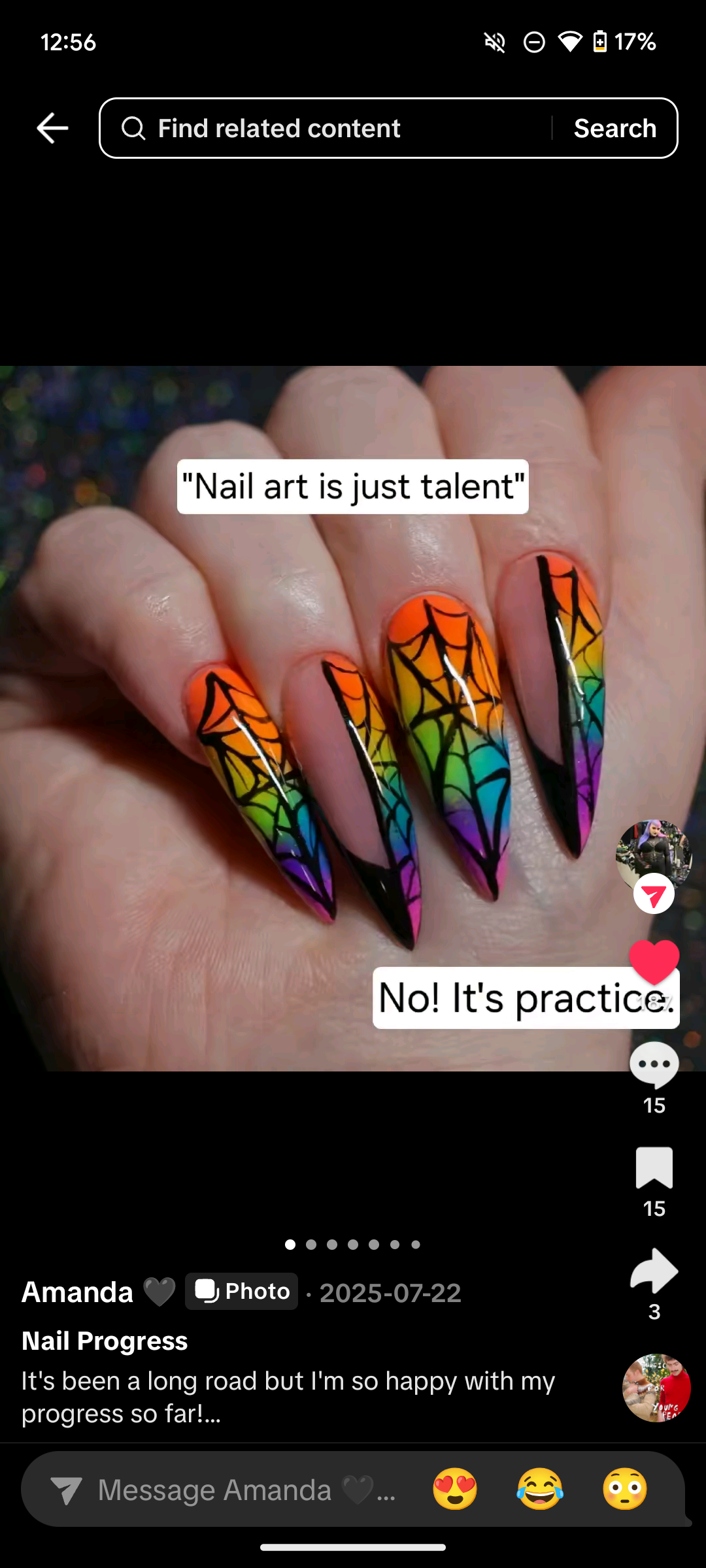
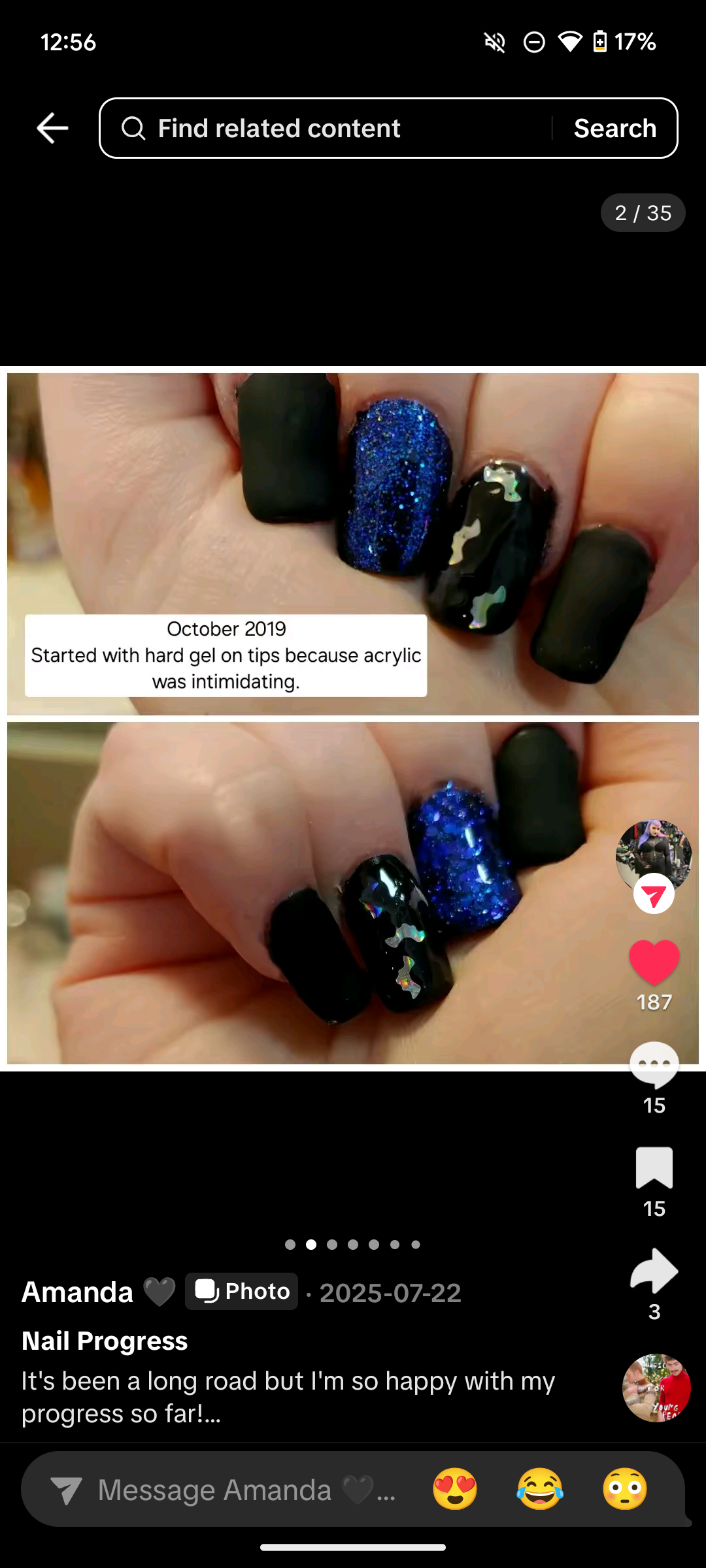
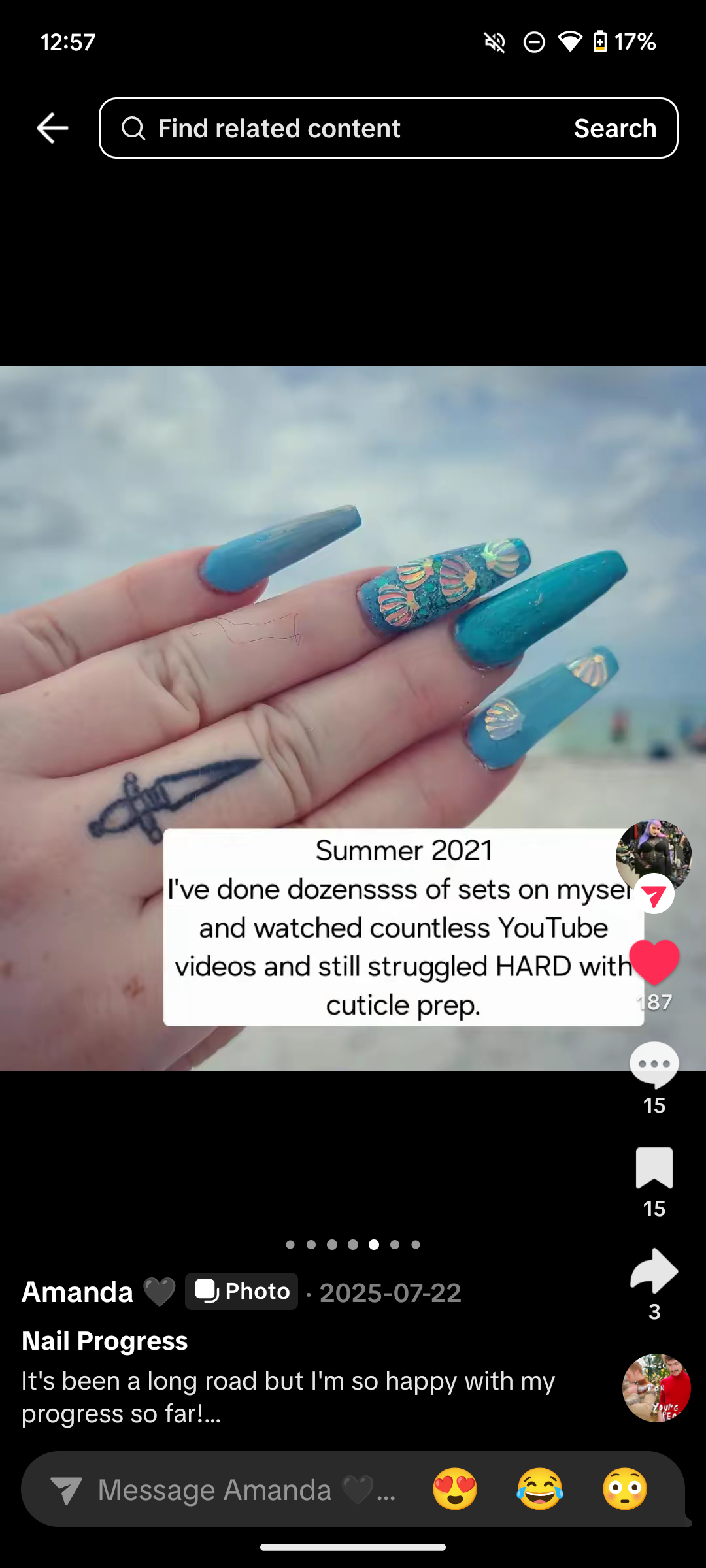
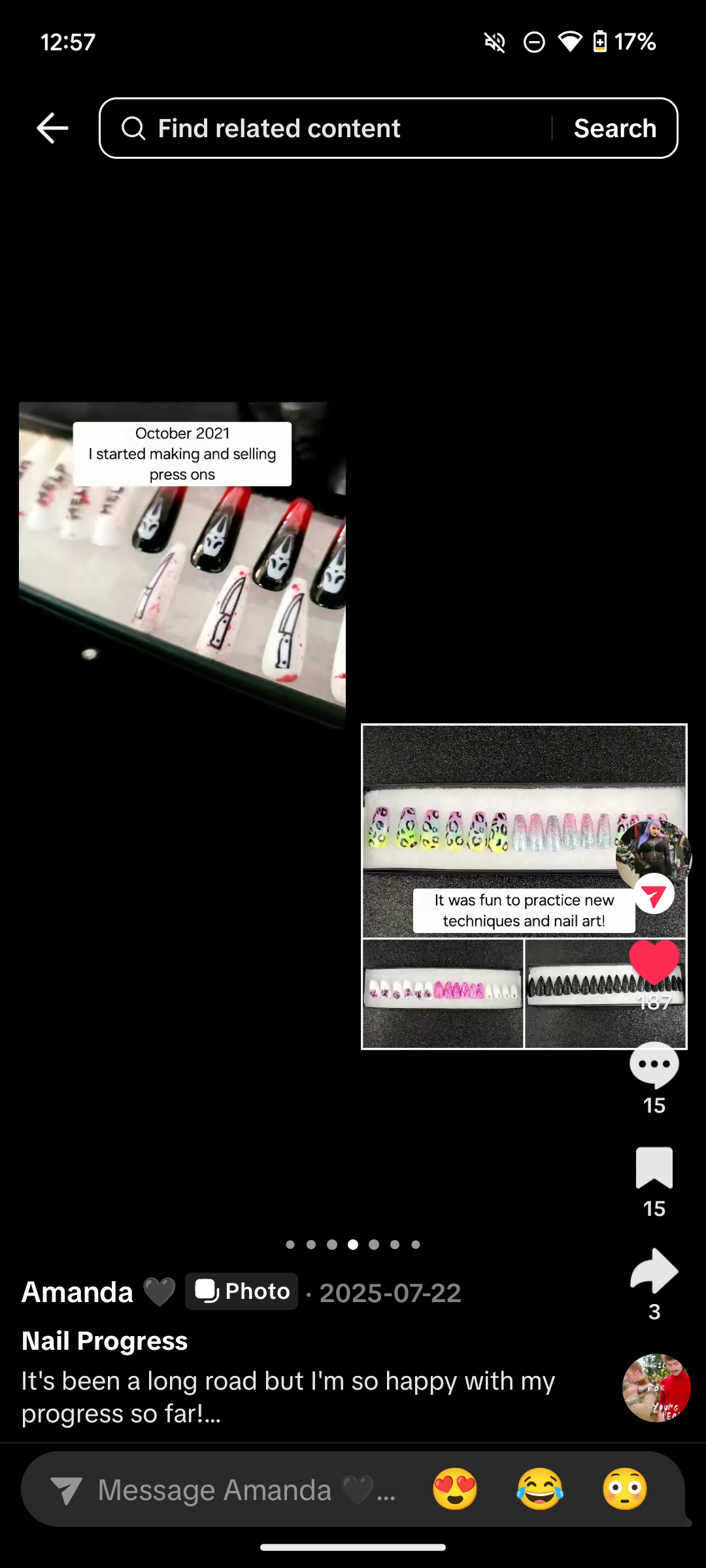
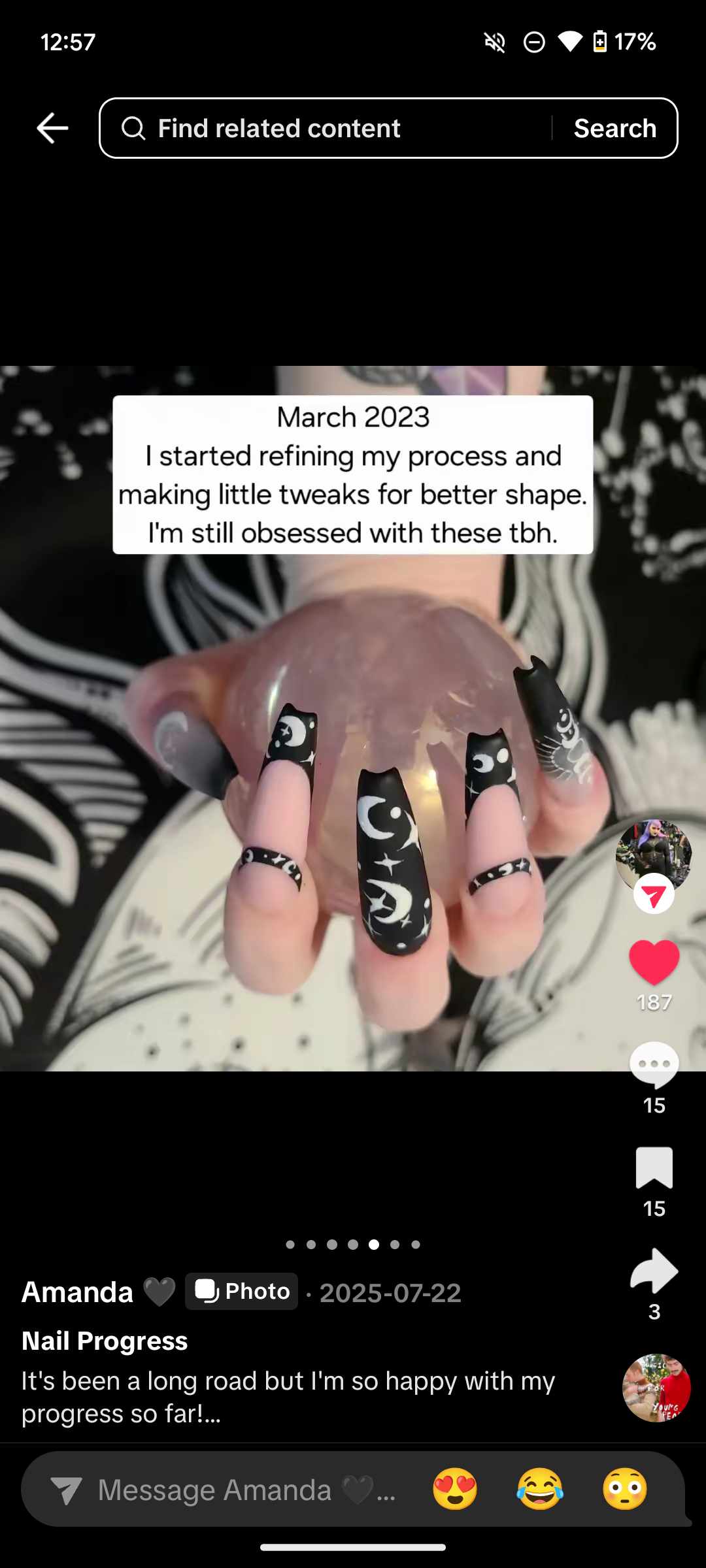
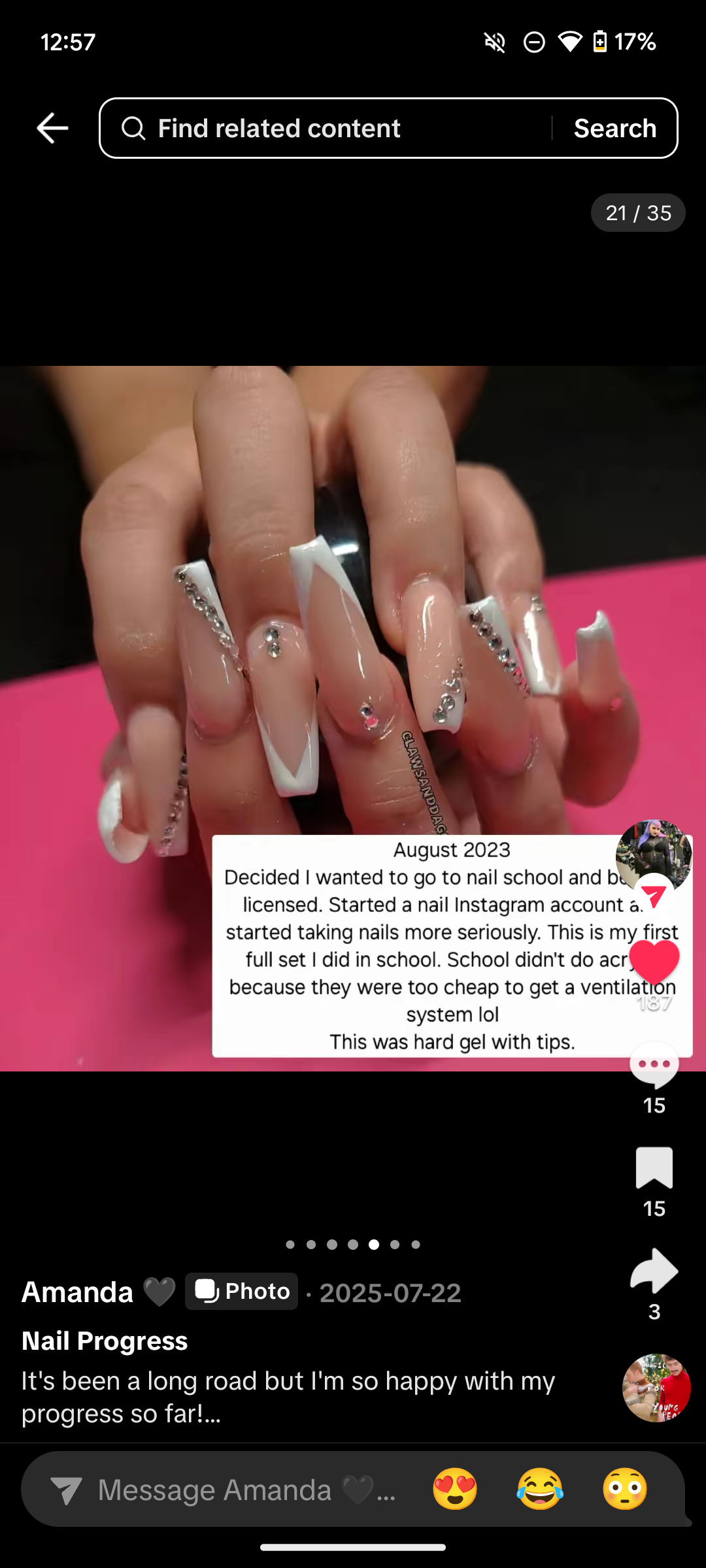
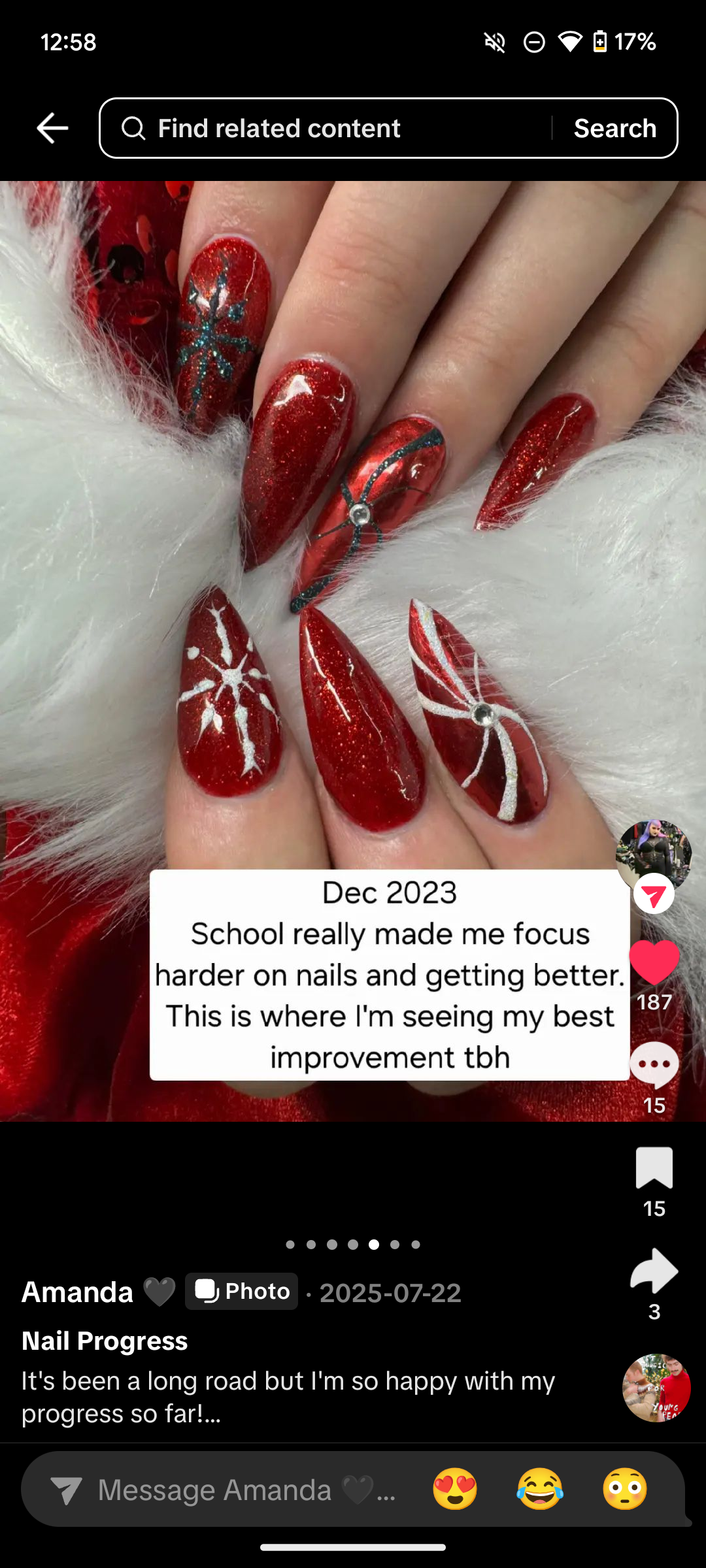
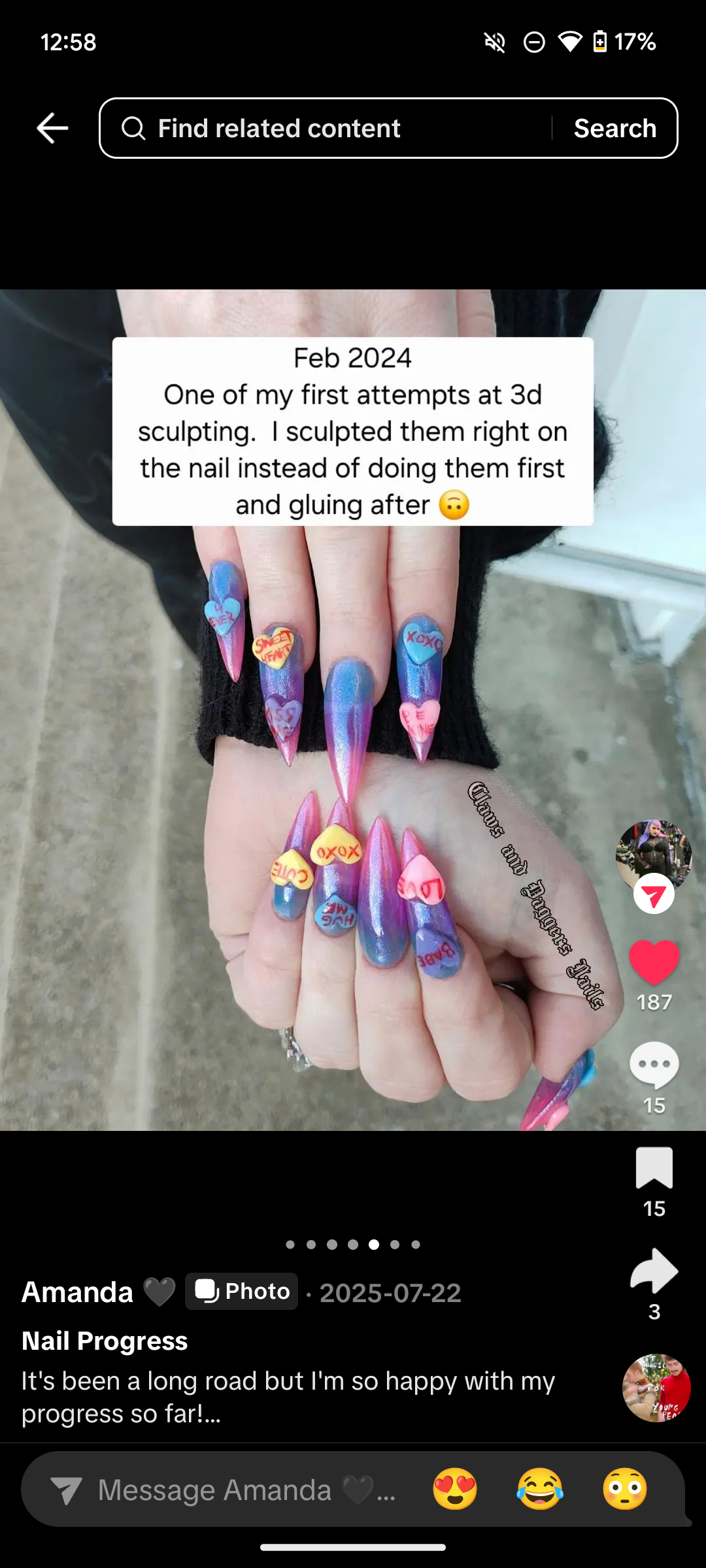
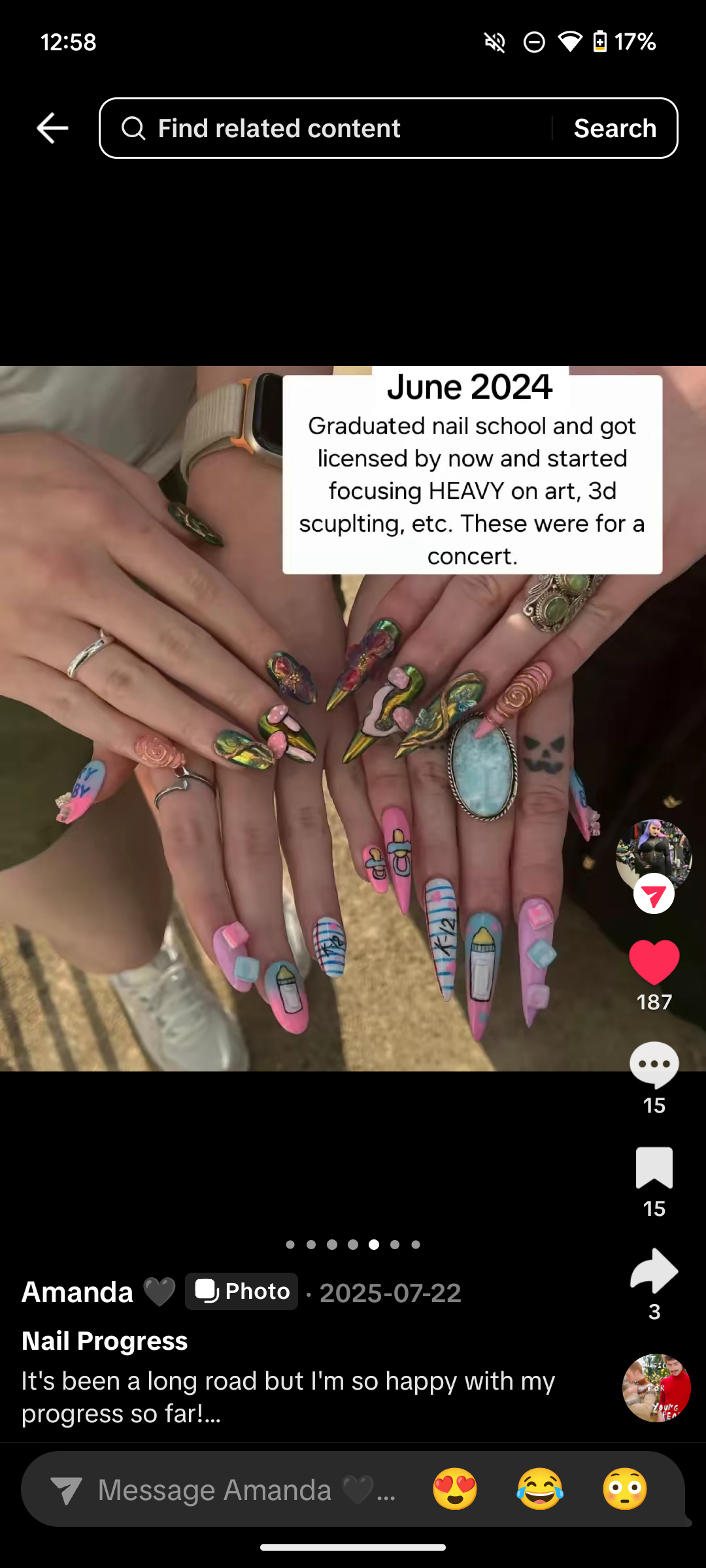
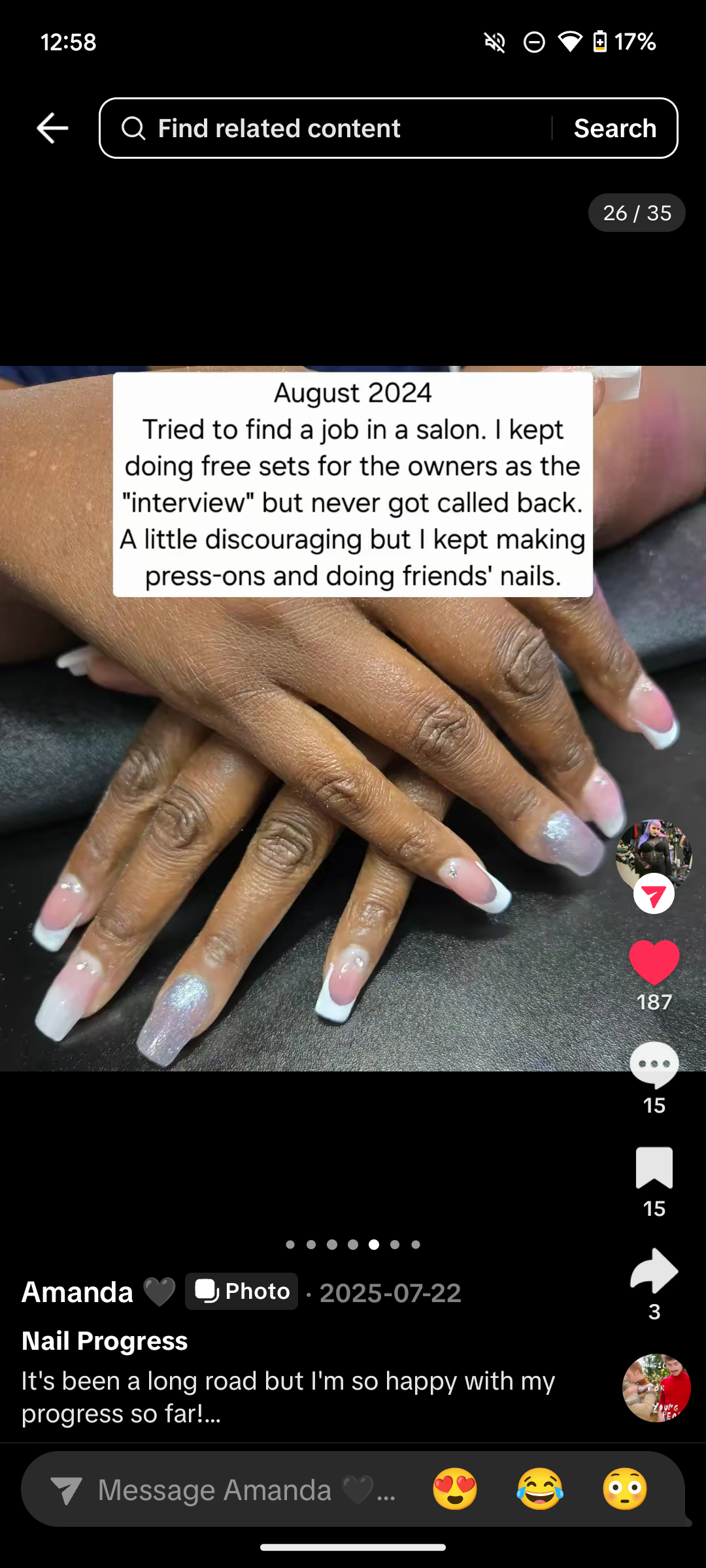
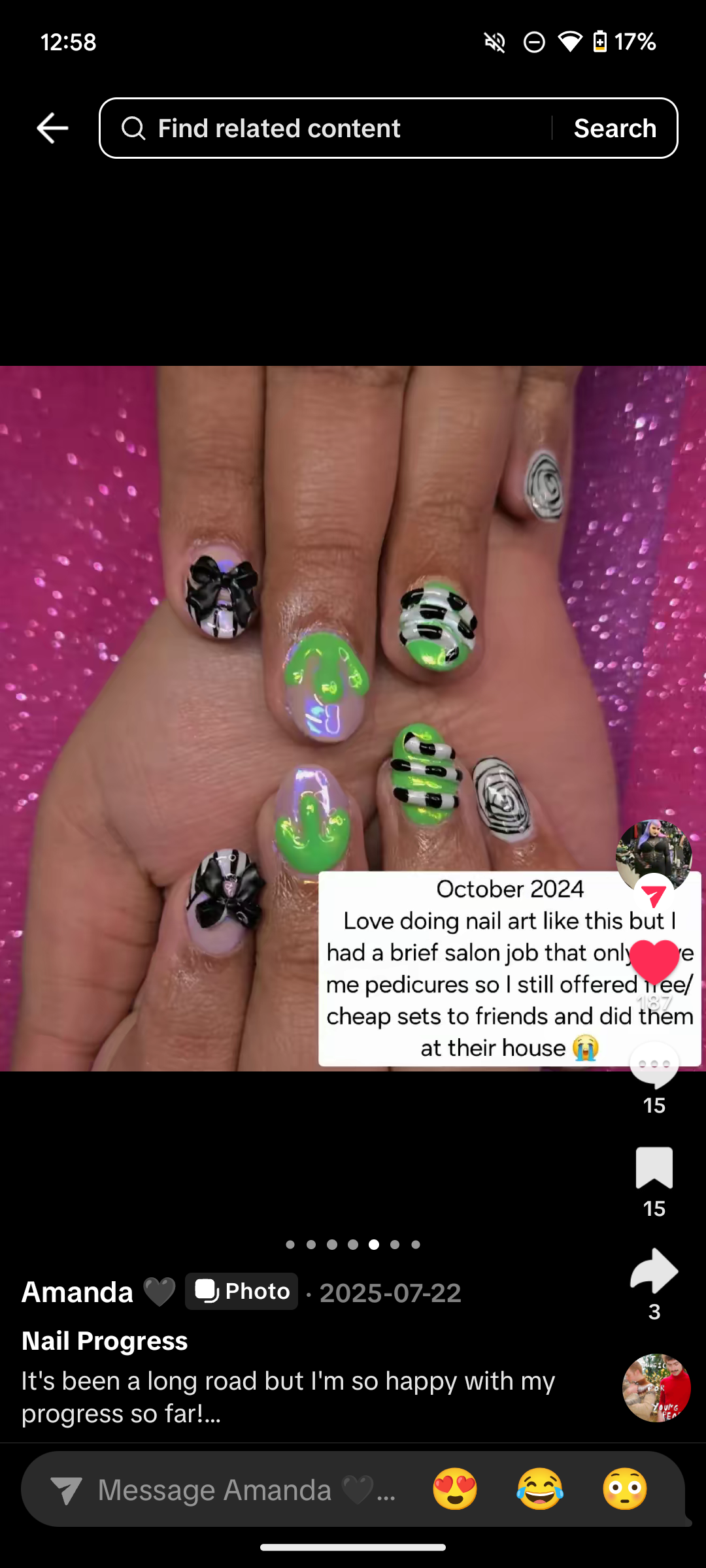
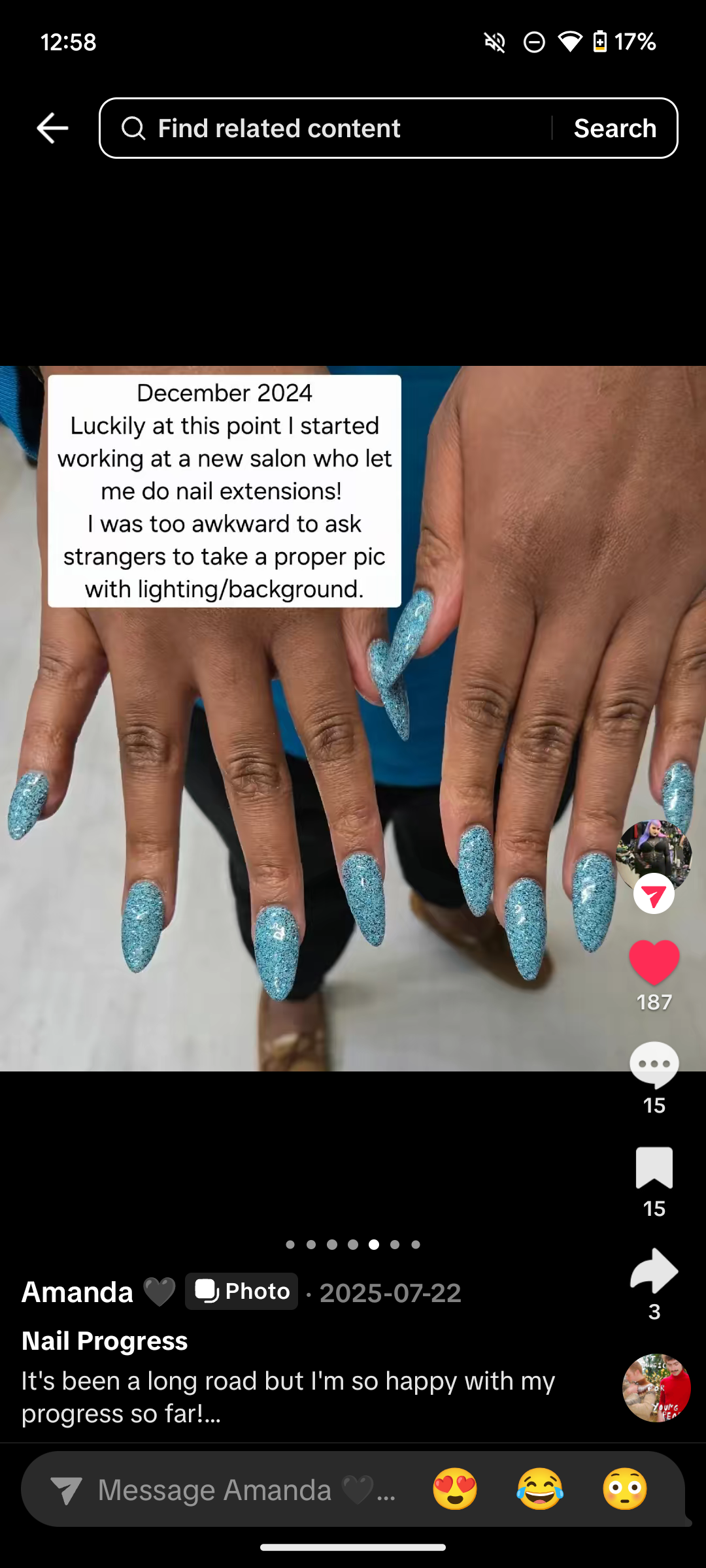
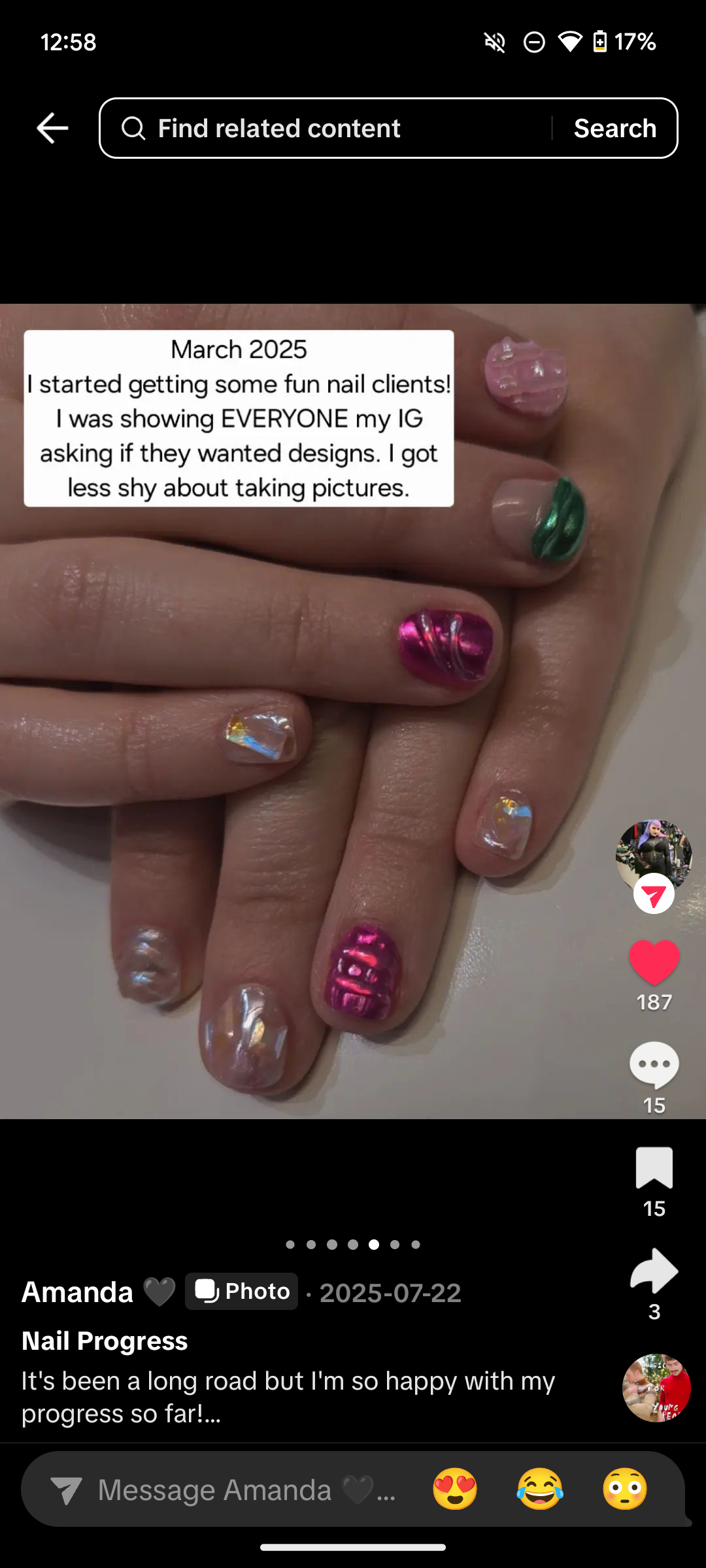
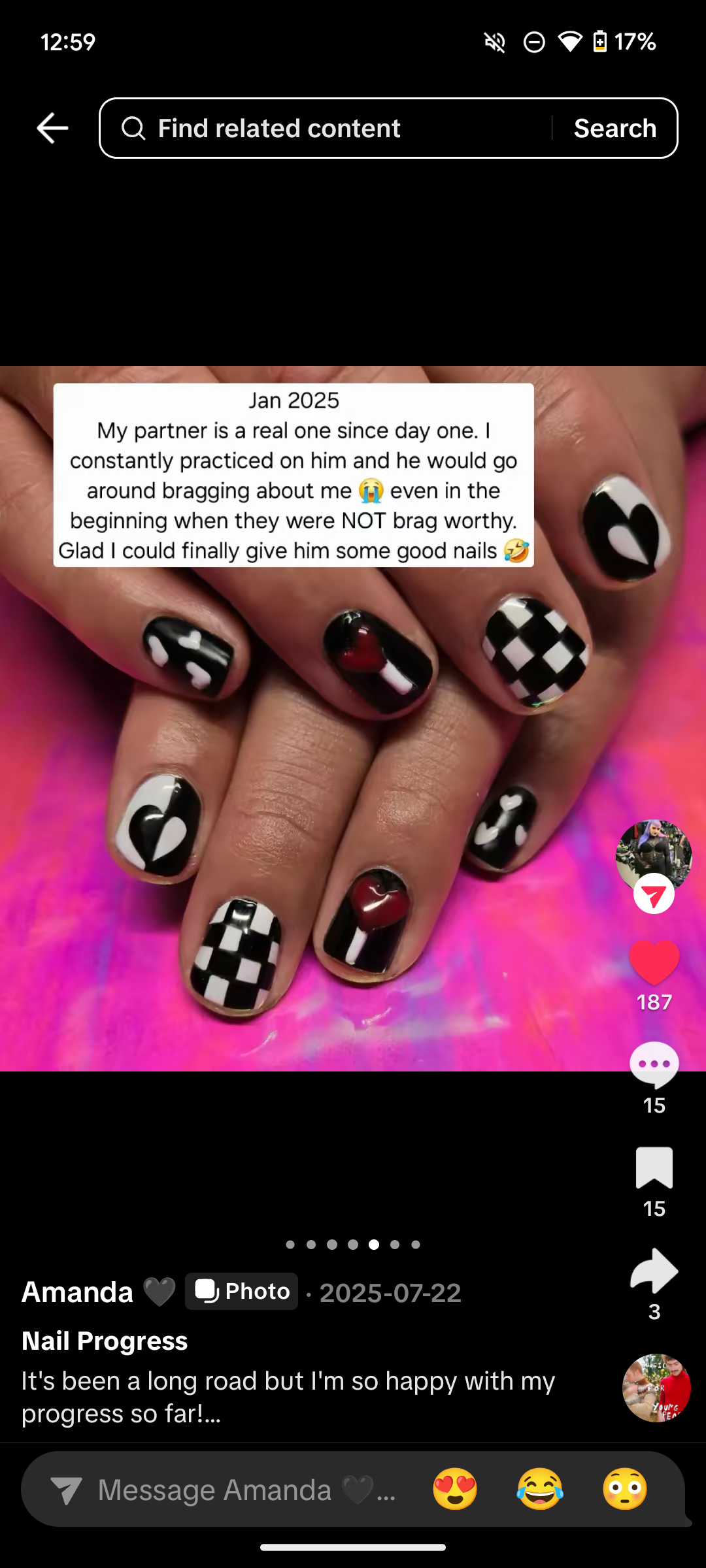
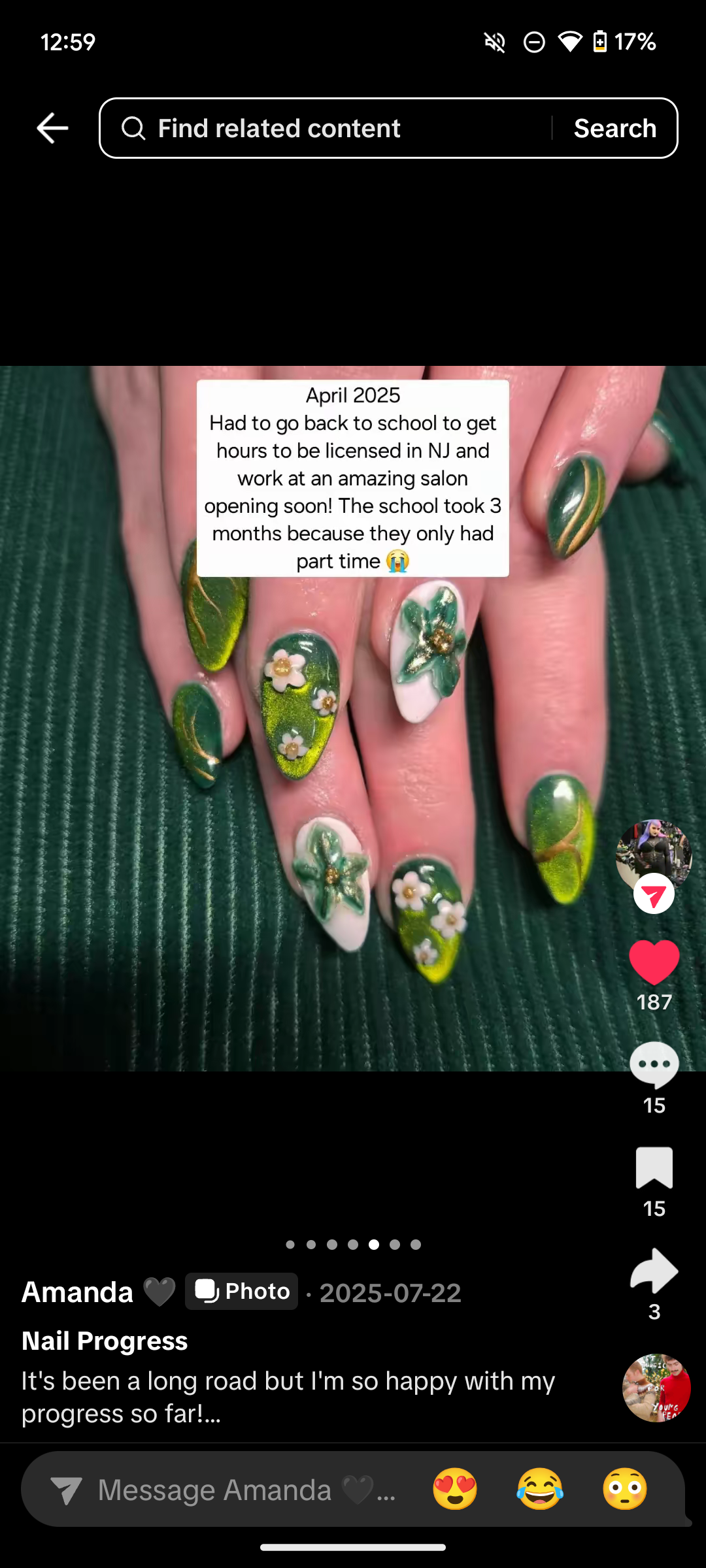
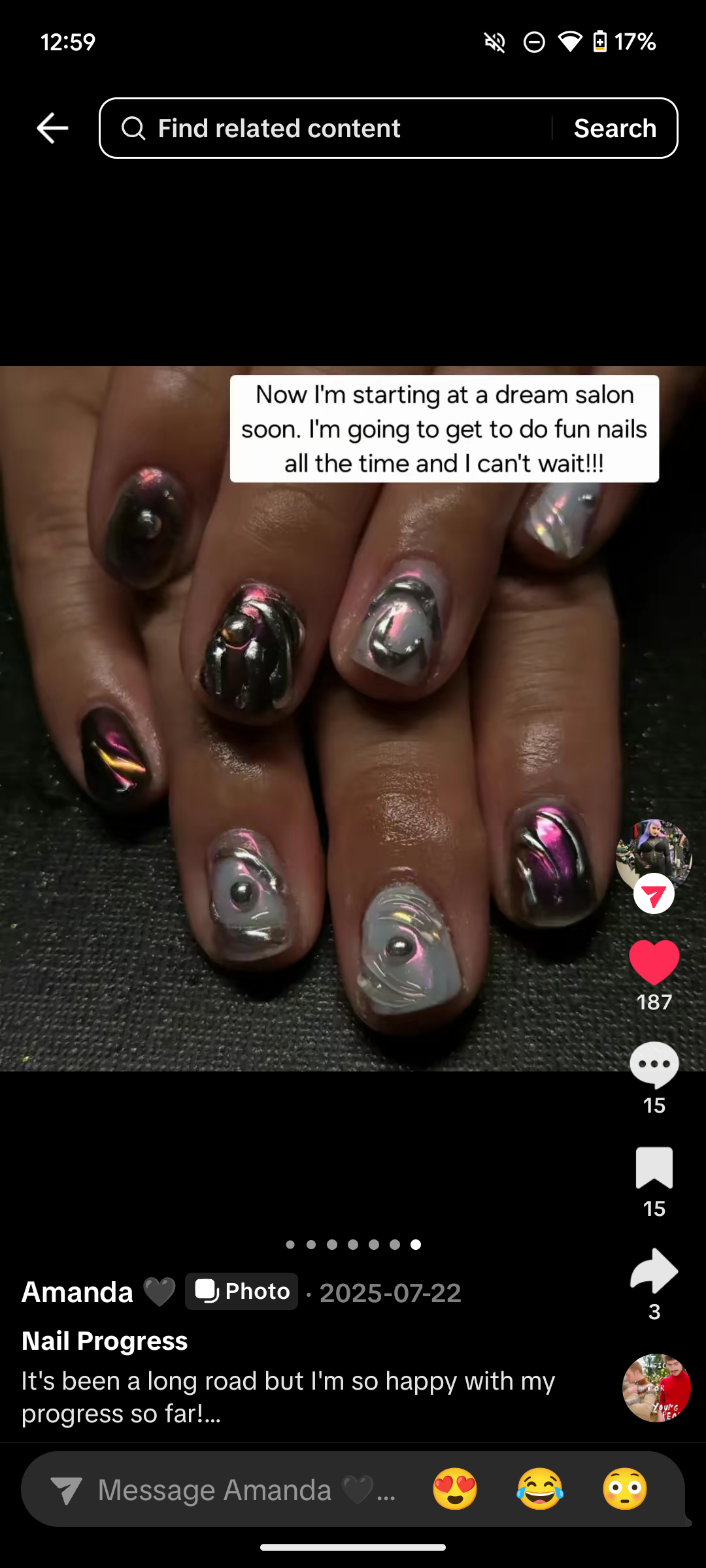
What hit me about reading her story is that I had, without realizing it, assumed she was an overnight success. I had been following her, watching her content, seeing the results, and somewhere in my brain I had collapsed the timeline of her journey into something much shorter than it actually was. Actually sitting with the full arc of what it took, six years of persistence, roadblocks, plateaus, and showing up anyway, made me realize how often we do that to each other and to ourselves. We see where someone is and we assume they got there quickly, and then we measure our own pace against a timeline we invented.
Nothing about building something real is overnight. The sooner we stop expecting it to be, the more honest and sustainable our relationship with our own process becomes.
Six Views. Then 340. And Why the Math Actually Tells a Different Story.
I've rewritten this section more than once because I needed to give it time. I stepped back, and let the video breathe. And the numbers now tell a more honest story than they did when I was writing from 6 views and a quiet afternoon.
As of 17 days and 23 hours after uploading: 340 views.
On a video that is nearly 30 minutes long. And my first instinct is to say that's not bad at all, because it genuinely isn't, and here's why.
Let me do the math out loud, because I think this reframing is important for anyone who makes long-form content and measures themselves against short-form metrics.
Current engagement: 340 views x 30 minutes = 10,200 view-minutes (170 hours)
That is the total amount of audience time this video has generated. Now let's apply that same energy to a shorter format, a lower barrier to entry, and see what the numbers would say:
At 13 minutes long: 10,200 / 13 = 785 views
At 10 minutes long: 10,200 / 10 = 1,020 views
If not greater. Asking someone for 30 minutes of their day is a significant barrier to entry. The people who clicked and stayed are not casual viewers. They are highly invested. They came looking for something real and they found it and they stayed for nearly half an hour. That means something. My best performing video on this channel sits at 6.6k views and I have 500 subscribers. That video is 13 minutes long. Easily digestible. In the same 17 days that older video got 909 views. If this video was 13 minutes long, it would be sitting at around 785 views, which proves my point exactly.
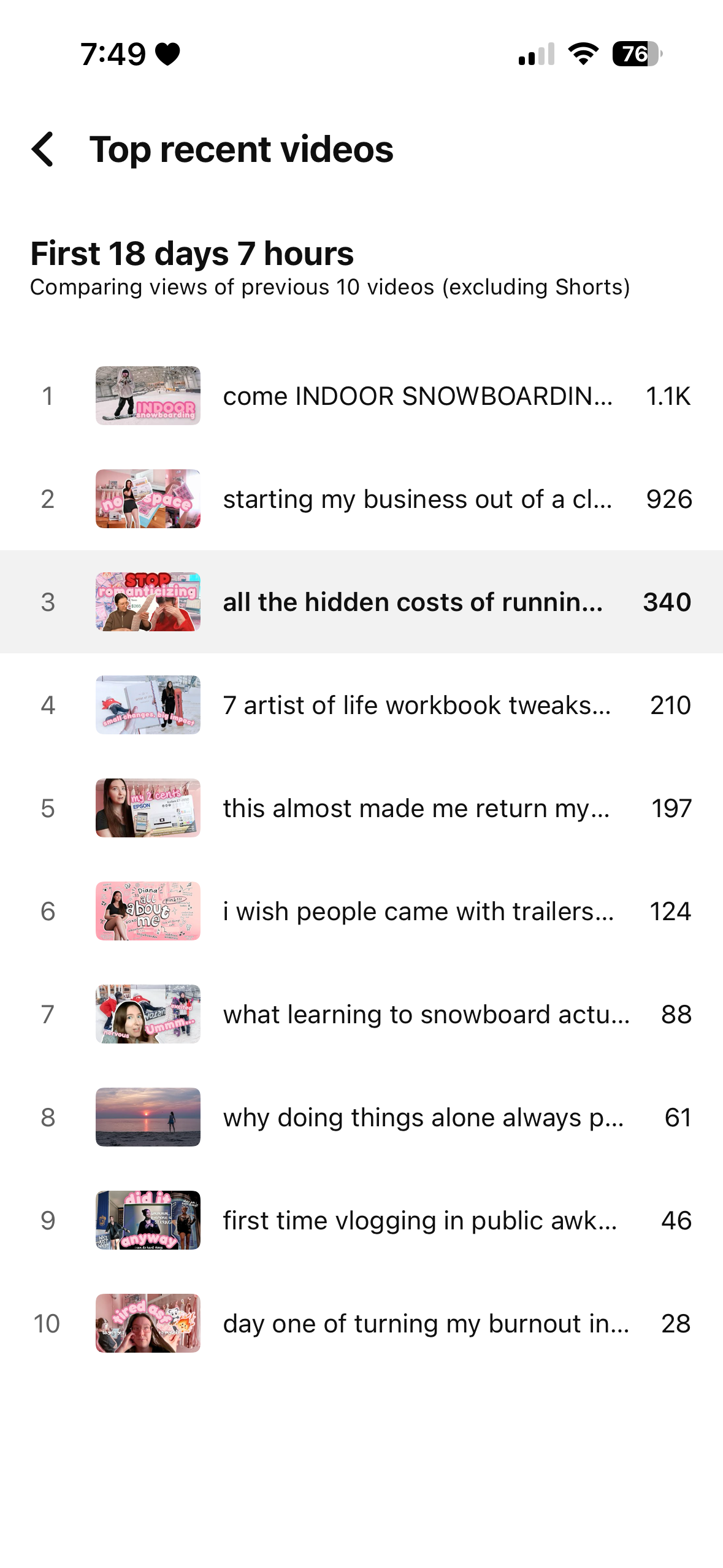
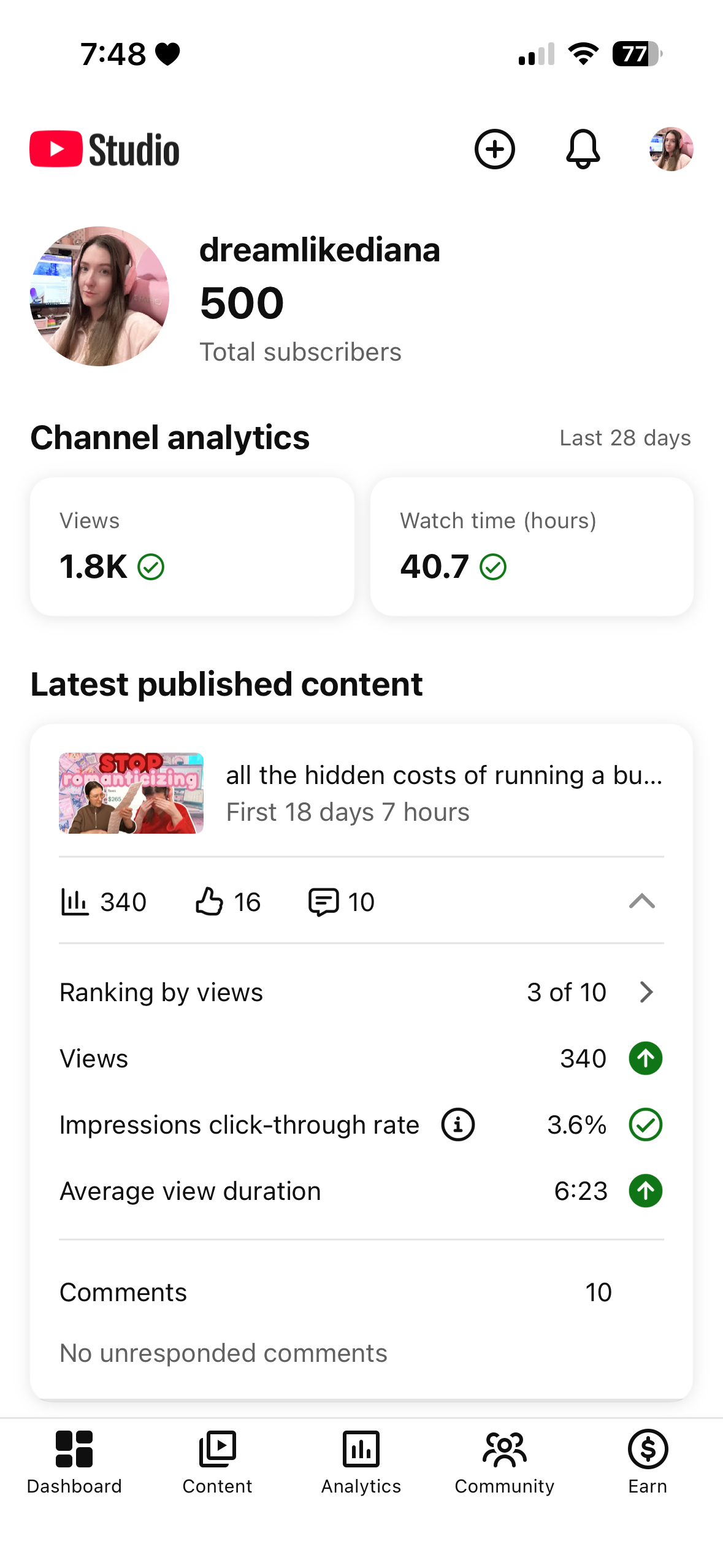
Length is a factor. The thumbnail matters. The description matters. Low views on a long video are not the same as low views on a short one, and anyone who sees a number without considering the context of the format is not reading the data correctly.
People are judgmental about view counts. They see a small number and assume it's a bad video. I see a small number and I look at the length first. The click-through. The retention. The format. 340 people chose to spend 30 minutes with me. That is not nothing.
And speaking of reframing numbers, I want to bring in something that genuinely shifted my perspective on where I am right now as a YouTube channel. Katie Steckly, a social media strategist who makes six figures from her business and her YouTube channel, has said that 100 YouTube subscribers is the equivalent of 1,000 Instagram followers and 10,000 TikTok followers. I have 500 subscribers. So by that ratio:
Instagram equivalent: 500 / 100 x 1,000 = 5,000 followers
TikTok equivalent: 500 / 100 x 10,000 =50,000 followers
YouTube is built on high intent and long-form investment. TikTok and Instagram are largely built on passive scrolling. Earning a YouTube subscriber is genuinely harder than earning a follow on any other platform because the person has to actively decide they want more of you. They have to opt into a longer relationship. That's not the same thing as a double tap while someone is waiting in line at the grocery store.
Katie also reiterates constantly that the only way to fail on YouTube is to quit. As long as you keep showing up, the reality and the possibility will both be there. She didn't start making money from it overnight. It took her years. That's the pattern across every creator and business owner I respect. None of it is overnight. The library builds slowly and then all at once.
Which brings me to the most important mindset shift I want to offer here, because posting on social media for years has taught me things no course ever could. It taught me how to film. How to edit. How to read an audience. And one of the most valuable things it taught me is this: you will have plenty of videos that flop. Videos that get 100 views or whatever you personally consider low traction. But occasionally you'll have ones that hit 1k to 5k, which feel like a real win. And then there will be outliers, the ones that hit 10k and keep climbing, the ones you forgot about that quietly keep bringing in new people every single week.
That has happened to me multiple times on TikTok and YouTube Shorts. A video I stopped thinking about suddenly becomes the one that's driving traffic months later. We are building a library. Libraries take time. We never know what's going to work until it works, and 50 views does not mean a bad video. If 50 people walked through my front door right now I would have absolutely no room to fit them. 50 is a lot. 1k is better. An outlier is even better than that. But small is not bad. Small is the beginning of the library.
I built this blog and site from scratch, and now I reach 500,000 people a month. That didn't happen overnight. I got the .com in 2019 and have been working on it consistently ever since. All it took was a few blog posts to push to the first page of Google. I know I can grow. I know the universe loves a stubborn heart. I've proven it to myself enough times to trust it now. Everything I do is for the long game. This video, this channel, this whole library I'm building. It is all evergreen. It will all matter more later than it does right now. And I'm okay with that.
Any exposure is still exposure. Keep going.
A Taste of What's Actually In the Video
This post is the view from behind the camera. The process, the cost, the lessons, the math. The video is where the actual content lives, and I want to give you a real sense of what's waiting when you hit play.
The moment I think will hit hardest for a lot of creators is the copycat section. Week of Christmas, I found someone selling what was very clearly an AI-generated copy of my original hand-drawn work. Blatant. Obvious. And almost certainly not limited to just my designs. It's the kind of thing you know is coming eventually when you put original work into the world, and it still knocks the wind out of you when it actually happens.
Here's what I know now that I didn't know when I launched: you automatically own the copyright to anything you create, but registered copyright is a separate step and a separate fee. Through copyright.gov, unpublished work can be registered in batches of up to 10 for $45. Published work is $65 per piece. And once something is published, it is published. You can't unpublish it to access the lower rate. I looked into it. That is genuinely just not how it works. I talk through all of this in the video because I wish someone had told me before I launched, not after I found my work somewhere else. If you are a creator with original work in the world, this section is not one to skip.
And then there's what I called the crap casserole. My name for everything nobody includes in the thumbnail. The unglamorous, tedious, sometimes overwhelming side of doing something you actually love. The part that makes "if you love what you do you'll never work a day in your life" one of the most misleading things ever said about creative entrepreneurship. It is still work. It will always still be work. There will always be parts of it that are hard and draining and not what you pictured. And that does not mean you are doing it wrong. It means you are doing it for real.
A Note Before You Go
This is not for everyone. Having your own business gets glorified constantly. The lifestyle, the freedom, the being your own boss narrative. What isn't out there, not in any honest and consistent way, is an accounting of what the lifestyle actually requires of you.
It requires a lot. It is a lot. Not in a way that means you're doing it wrong. In a way that means you're doing something genuinely hard and choosing to keep doing it anyway. That choice doesn't get easier just because you love it. It just becomes more yours.
I know I'm building something big. I know I'm meant for more than where I am right now. I know I have to get through the ugly to receive the beautiful, and the ugly is not a sign that I'm failing. It's a sign that I'm in it. Really in it. Doing the actual work, not the aesthetic version of it.
I was sitting at my desk a week before I published this video, crying my eyes out, wondering if I was a failure. Then I got the LLC email. Then a brand partnership inquiry came in. Then I packaged another order. Then I uploaded the video, got a fever by midnight, and spent the next few weeks sick and recovering and still showing up.
That's what this looks like. The whole thing, not just the parts that photograph well.
If you're in it too, this video is for you.
Till next time!
With love & gratitude,
Diana